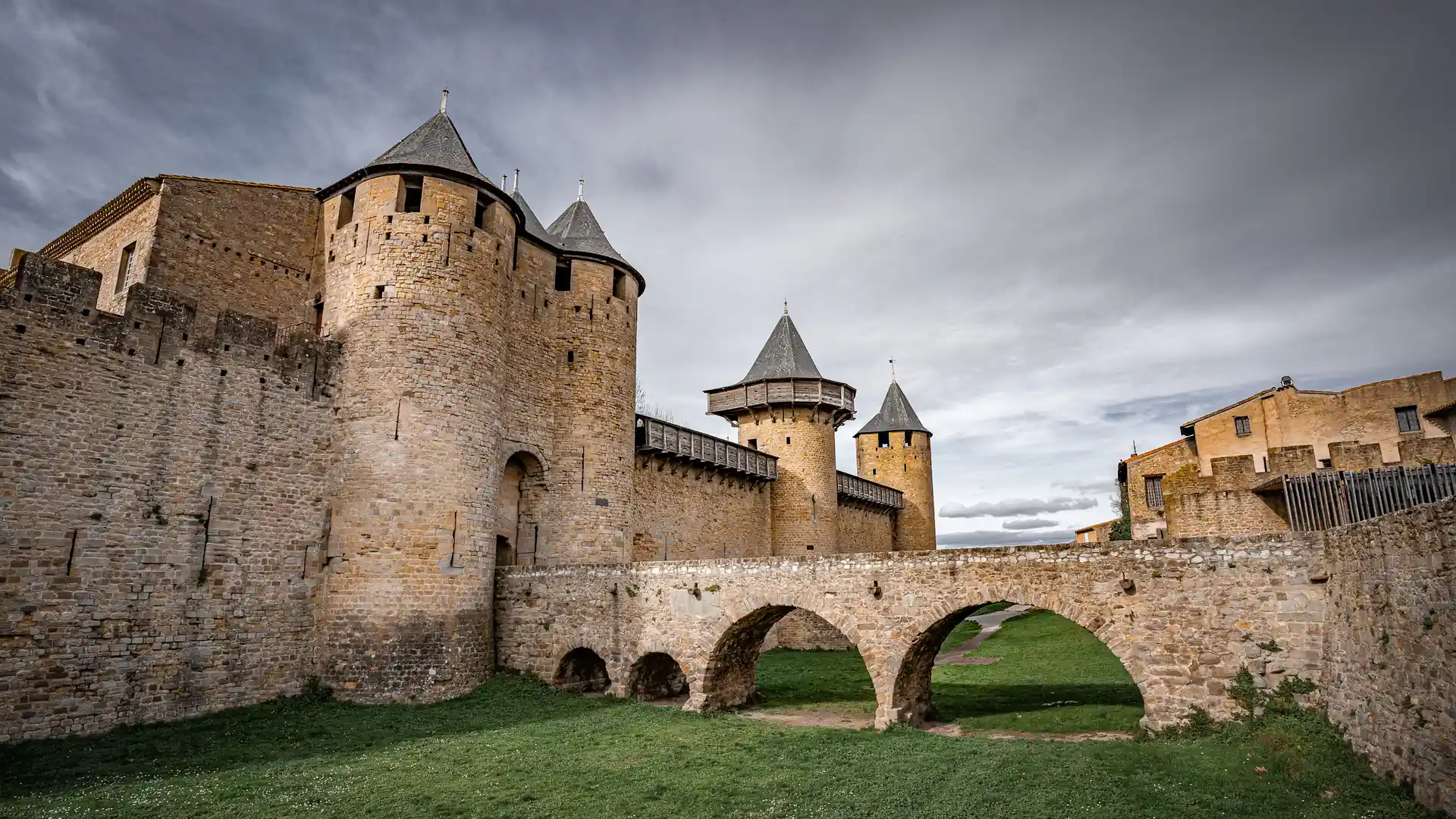
The circuit, gate by gate
Six of the named gates and towers you meet on a walk around the walls, starting at the main entrance and working round by the west.
- Porte Narbonnaise The east gate
Built around 1280 under Philip III, with twin towers and a double portcullis — still the cité's main entrance. The drawbridge in front is Viollet-le-Duc's addition; the gate never had one.
- Tour du Trésau The treasury tower
Built in the same Philip III campaign as the Porte Narbonnaise beside it, and restored in 1874 during Viollet-le-Duc's campaign.
- Tour Pinte The tallest tower
A square watchtower from the Visigothic era and the tallest tower in the cité, rising from the Château Comtal on the western side.
- Porte d'Aude The west gate
Faces the river just below the château, with false doorways hidden behind tall arches to confuse attackers, and a round arch of alternating brick from the Visigothic period.
- Porte Saint-Nazaire The south gate
Set inside a square tower with a 90-degree bend in its passage, so defenders could fire into attackers from two sides at once; Viollet-le-Duc rebuilt it between 1864 and 1866.
- Tour de la Justice On the west front
Built straight after the siege of 1240 — the last attack the cité faced — on the western side of the inner wall.
Since September 2024 the ticketed route has run the full circuit of the inner rampart, about 1,500 metres starting from the Château Comtal. The Lices between the two walls are free to walk.
Fast facts
- Two rings of wall
- An inner Gallo-Roman wall and an outer 13th-century wall, with the Lices corridor between them
- 52 towers and barbicans
- Named towers and barbicans ring the cité, built up over roughly a thousand years
- The free part
- The cité's lanes, shops and the Basilica of Saint-Nazaire cost nothing to walk into
- The ticketed part
- Only the Château Comtal and its ramparts walk, run by the Centre des monuments nationaux
Reading the double wall
Two walls, two eras
The inner wall began as a Gallo-Roman circuit, in place by the 4th century, and seventeen of its original towers still stand, reworked to varying degrees; the Trencavel viscounts rebuilt it in the 12th century. The outer wall came after the French crown took the cité in 1226, and royal building went on under Philip III and Philip IV into the early 14th century — a wide, flat corridor called the Lices separates the two.
What the ticket is actually for
The cité itself is a living town — cobbled streets, shops, hotels, the Basilica of Saint-Nazaire — and its streets are free to walk at any hour. The Château Comtal and the ramparts walk that starts inside it are the one part of the site the Centre des monuments nationaux tickets. If a page talks about 'entry to the cité', it almost always means that castle-and-ramparts combination, not a gate fee for the town.
The roofs everyone argues about
By the 19th century the cité was crumbling, and in 1849 the government decided its fortifications should be demolished. Local opposition, led by Jean-Pierre Cros-Mayrevieille and backed by Prosper Mérimée, reversed that decision, and from 1853 the rebuilding fell to Eugène Viollet-le-Duc, who held the job until his 1879 death, when his pupil Paul Boeswillwald carried it on. His steep slate roofs on the towers are the restoration's most recognisable addition, and the one still argued over — critics, from his own lifetime onward, have pointed out that castles in the region more typically carried low-pitched roofs of Roman-style clay tile. UNESCO's description of the site credits the restoration campaign itself with part of its exceptional importance, rather than treating it as a flaw to look past.
The basilica nobody pays for
Entry to the Basilica of Saint-Nazaire is free; it sits outside the château ticket. It's a hybrid building — a 12th-century Romanesque nave giving way to a Gothic transept and choir built between 1269 and 1330 — and the join between the two styles, heavy round arches opening into slender pointed ones under stained glass, is one of the cité's better free sights.
Deeper into the cité
Timing
The best time to visit Carcassonne
Which months are bearable, which hours are calm, and when the cité empties out.
Open this one →On foot
A walking route around the medieval city
The gates, the towers and the Lices — a circuit that uses the free parts of the cité to see both walls properly.
Open this one →Getting there
How to get to Carcassonne from Toulouse
The direct train, the A61 drive, and the walk up from the station that catches people out.
Open this one →Inside the walls
What to see inside the Château Comtal
The courtyards, the stonework museum, and the start of the full rampart circuit.
Open this one →Comparing two restored icons
Carcassonne vs Mont-Saint-Michel
Both UNESCO-listed, both rebuilt into the silhouette everyone recognises — but one depends on the tide and the other doesn't.
Open this one →Visiting with children
Carcassonne with kids
What's realistic for younger legs, what to watch for on the ramparts, and the free parts that do the heavy lifting.
Open this one →The restoration explained
Viollet-le-Duc's restoration of Carcassonne, explained
Why a near-ruin became France's most photographed medieval skyline — and why the roofs are still argued about.
Open this one →- Independent guide We research the cité and link out to Viator — we don't run the ticket desk
- Checkout happens on Viator Card details go straight into Viator's own payment screen, never through us
- No markup added The price on Viator is Viator's own — we earn a commission, never a markup
- Cancellation terms shown first Viator shows its cancellation window before you confirm, not after
Before you plan the climb
What's actually free at the Cité de Carcassonne, and what isn't?
The cité's streets, shops, squares and the Basilica of Saint-Nazaire are free to walk into at any hour. The one thing that's ticketed is the Château Comtal and the ramparts walk that starts inside it, run by the Centre des monuments nationaux.
How many towers does Carcassonne have?
Fifty-two towers and barbicans, spread across the inner and outer rings of wall and built up in layers from the Gallo-Roman period to the early 14th century.
Are the famous conical roofs on the towers original?
No. They're a 19th-century addition from Eugène Viollet-le-Duc's restoration, which he led from 1853 until his death in 1879. Castles in this region more typically carried low-pitched clay-tile roofs, and the slate cones remain the most debated part of his work.
How do I get from Toulouse to Carcassonne?
Carcassonne sits about 80 km east of Toulouse on the A61 motorway and the main rail line, with direct trains through the day taking roughly 40 minutes to an hour depending on the service.
Is the Basilica of Saint-Nazaire worth a stop?
Yes, and it costs nothing. It's a Romanesque nave running into a Gothic choir and transept, with stained glass from the 13th and 14th centuries showing scenes from the lives of Christ and the apostles.
How long should I set aside for the Château Comtal and ramparts?
Around two hours if you walk the full rampart circuit, which has run the whole 1,500 metres of the inner wall since September 2024. Two intermediate exits let you shorten it, and the free parts of the cité need time of their own.
When is Carcassonne at its quietest?
November to March, outside the Christmas and Easter weeks, is the calmest stretch. In the warmer months, arriving at opening time or after mid-afternoon avoids the busiest hours around midday.
How does Carcassonne compare to Mont-Saint-Michel?
They're both UNESCO-listed, but the resemblance mostly stops there — Carcassonne is a landlocked double-walled town you can reach by road any day of the year, where Mont-Saint-Michel is an abbey on a tidal island, reached by a bridge across the flats of its bay. We cover the difference properly in the comparison guide below.